Exploration of the Repentance Aspect of Pwahaci Dance in Seren Taun Ritual in Cigugur, West Java
DOI:
https://doi.org/10.31091/mudra.v41i1.3146Keywords:
Repentance, Pwahaci Dance, Sunda Wiwitan, Cigugur, BalthasarAbstract
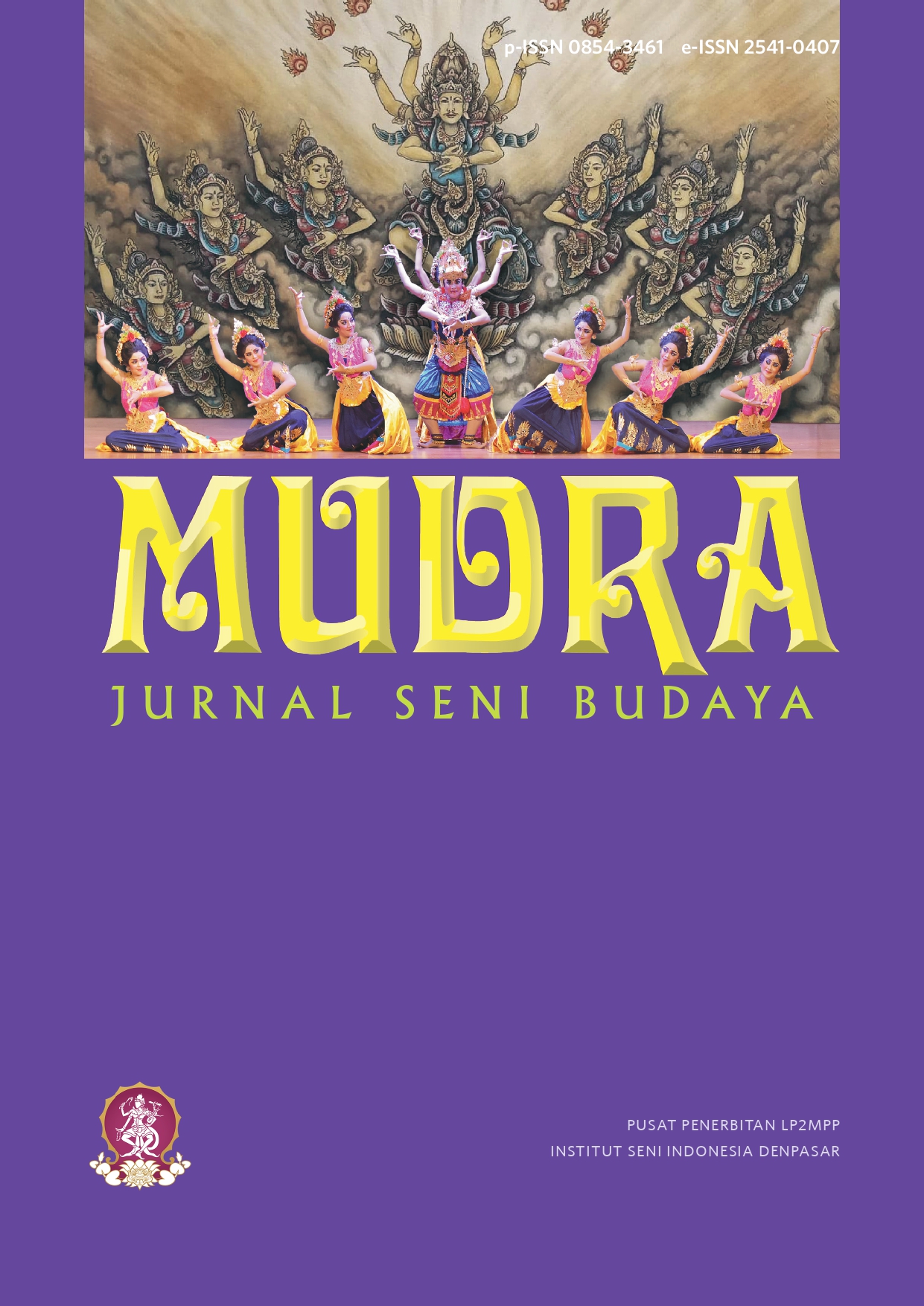
Repentance shows man's awareness of his weakness before God. As weak creatures, humans should communicate with God to be grateful for the goodness given and also ask God for help. The provision of help from God to humans is depicted as beautiful, like a mother's love for her child. This research uses a qualitative approach with the main focus on the meaning of the Pwahaci dance repentance in the seren taun ritual in the Cigugur Kuningan community in West Java. Data collection was done by observation, interview, and literature study. The data obtained was then reduced to make it more focused, and an in-depth analysis was carried out using Hans Urs Von Balthasar's religious aesthetic perspective. The results of the data analysis are then presented in the form of scientific writing. The result of this research is that the figure of Dewi Pwahaci is understood as an intermediary between humans and God. Communication is done through a sacred dance, the Pwahaci Dance. This is manifested in the form of meditative Pwahaci dance movements full of truth, goodness, and beauty.
Downloads
References
P. Chakravorty, “The body and the contagion: a symbiosis of yoga, dance, health and spirituality,” in The Dancing Body, Routledge, 2024, pp. 136–148. https://doi.org/10.1080/19472498.2022.2144329
A. Dewa, “Teologi Inkarnasi Dan Gereja Yang Inkarnatoris Menurut Hans Urs von Balthasar,” Media: Jurnal Filsafat dan Teologi, vol. 2, no. 1, pp. 25–59, 2021. https://doi.org/10.53396/media.v2i1.18
R. C. Hikota, “The Christological Perichoresis and Dance,” Open theology, vol. 8, no. 1, pp. 191–204, 2022. https://doi.org/10.1515/opth-2022-0202
C. Panera, “Embodying heaven: The ancient philosophy of dance in China,” Journal of Daoist Studies, vol. 16, no. 16, pp. 19–40, 2023. https://doi.org/10.1353/dao.2023.0001
L. P. Hati, F. Indra, A. T. Sikumbang, and A. Sitompul, “Between Cult and Spirituality: A Theological Interpretation of Pilgrimage Practices at Sacred Sites in the Nusantara.,” Pharos Journal of Theology, vol. 106, no. 4, 2025. https://doi.org/10.46222/pharosjot.106.4026
C. V. Batubara, A. D. Ritonga, and S. Ritonga, “Indigenous Theologies in Indonesia: Syncretism, State Recognition, and the Resilience of Aliran Kepercayaan.,” Pharos Journal of Theology, vol. 106, no. 5, 2025. https://doi.org/10.46222/pharosjot.106.521
A. Sharma, “Decolonizing international relations: Confronting erasures through indigenous knowledge systems,” International Studies, vol. 58, no. 1, pp. 25–40, 2021. https://doi.org/10.1177/0020881720981209
M. Goodchild, “Relational systems thinking: That’s how change is going to come, from our earth mother,” Journal of Awareness-Based Systems Change, vol. 1, no. 1, pp. 75–103, 2021. https://doi.org/10.47061/JABSC.V1I1.577
M. Dhavamony, “Phenomenology of religion: Fenomenologi agama, terj,” G. Ari Nugrahamta et al.(Yogyakarta: Penerbit Kanisius, cet-11, 2011), vol. 66, 2011.
M. P. Gallagher, Mappe della fede: dieci grandi esploratori cristiani:[John Henry Newman, Maurice Blondel, Karl Rahner, Hans Urs von Balthasar, Bernard Lonergan, Flannery O’Connor, Dorothee Sölle, Charles Taylor, PierAngelo Sequeri, Benedetto XVI]. Vita e pensiero, 2011.
Y. D. Adisaputri and I. Widiastuti, “Territorial identification of vernacular settlement Cigugur through the practice of Seren Taun Ritual in Kuningan, West Java,” Procedia-Social and Behavioral Sciences, vol. 184, pp. 196–205, 2015. https://doi.org/10.1016/j.sbspro.2015.05.080
I. Kant, Critique of pure reason. BoD–Books on Demand, 2017. https://doi.org/10.1017/CBO9780511809576.004
I. H. Subiantoro, “Penciptaan Tari Jamparing Sekar Kinasih,” Panggung, vol. 32, no. 1, p. 518187, 2022. https://doi.org/10.26742/panggung.v32i1.1991
F. R. S. Pambuka and A. Saifuddin, “Whirling Dance as a Sufi Healing Method: A Phenomenological Study of the Sufi Dance Community in Surakarta,” Teosofi: Jurnal Tasawuf Dan Pemikiran Islam, vol. 13, no. 2, pp. 204–231, 2023. https://doi.org/10.15642/teosofi.2023.13.2.204-231
B. A. Rahawarin, F. Selatang, and I. S. S. Refo, “Kontekstualisasi teologis sakramen tobat dalam tradisi Sob Lor pada masyarakat Kei Provinsi Maluku,” Jurnal SMART (Studi Masyarakat, Religi, dan Tradisi), vol. 7, no. 01, pp. 115–128, 2021. https://doi.org/10.18784/smart.v7i01.1246
A. Nurhalizah, M. Hasanah, M. Hafizh, and M. Robiaturrifa, “Nilai-Nilai Pendidikan Islam dalam Estetika dan Spiritualitas Tarian Sufi,” Dinamika Pembelajaran: Jurnal Pendidikan dan bahasa, vol. 2, no. 4, pp. 195–208, 2025. https://doi.org/10.62383/dilan.v2i4.2506
H. U. Von Balthasar, “Glory of the Lord VOL 1: Seeing The Form,” 1982.
L. J. Moleong, “Metode Penelitian,” Bandung: PT Remaja Rosdakarya, 2006. http://repo.uinsyahada.ac.id/id/eprint/951
D. Sugiyono, “Metode penelitian pendidikan pendekatan kuantitatif, kualitatif dan R&D,” 2013. https://doi.org/10.29303/jipp.v10i1.3057
I. H. Subiantoro, “Estetika, Seren taun Antara Seni, Ritual, Dan Kehidupan,” Panggung, vol. 26, no. 4, 2016. https://doi.org/10.26742/panggung.v26i4.212
K. Rahner, “Foundations of Christian faith: an introduction to the idea of Christianity,” Relig. Stud. Rev., vol. 5, no. 3, pp. 190–199, 1979. https://www.jstor.org/stable/27660908
M. Kevin, “The Systematic Thought of Hans Urs Von Balthasar, An Irenian ertrieval,” 2002, A Harder & Harder Book The Crossroad Publising New York.
M. Situmorang, “Mendalami doktrin trinitas dalam pandangan Hans Urs von Balthasar,” Studia Philosophica et Theologica, vol. 18, no. 2, pp. 161–177, 2018. https://doi.org/10.35312/spet.v18i2.26
A. M. B. Nursananingrat, Umat Katolik Cigugur: sejarah singkat masuknya ribuan orang penganut ADS menjadi umat Katolik. Yayasan Kanisius, 1977.
F. Tambunan, “Komparasi Konsep Soteriologi Karl Rahner Dengan Hans Urs Von Balthasar,” Kerusso1, vol. 1, no. 1, p. 22, 2018. https://ejournal.sttoi.ac.id/index.php/kerusso1/article/view/41
Downloads
Published
Issue
Section
License
Copyright (c) 2026 Rufus Goang Swaradesy, Ignasius Herry Subiantoro, Nanda Sundari

This work is licensed under a Creative Commons Attribution-NonCommercial-ShareAlike 4.0 International License.
- Copyright on any open access article in a journal published by Mudra Jurnal Seni Budaya is retained by the author(s).
-
The Creative Commons Attribution License 4.0 formalizes these and other terms and conditions of publishing articles.